Supplier of High Chemical Resistance HDPE Liners
Blog · 2026-08-04 · 0 views
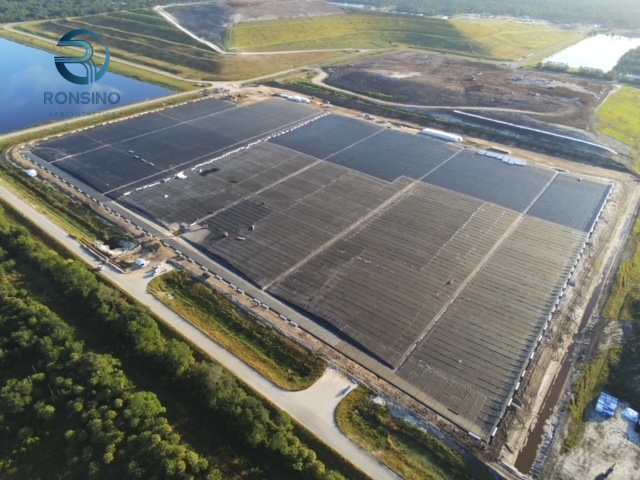
What is Chemically Resistant HDPE Liner Supplier
Professional chemical-resistant high-density polyethylene (HDPE) liner supplier, providing customized geomembrane products that can resist corrosion from strong acids, strong alkali, hydrocarbons, organic solvents and industrial complex liquids. Its chemical resistance comes from raw material screening, functional additive compounding and full-process quality control.
For engineering specialists, procurement supervisors, and EPC contractors, understanding the chemical resistance strengths of HDPE liner suppliers is critical for projects involving hazardous waste, mining, chemical storage, and industrial wastewater—where chemical compatibility is top priority. Industry data shows 21% of liner failures in corrosive environments stem from material performance issues, not installation errors. This guide provides a systematic framework for assessing, verifying, and selecting suppliers of chemically resistant HDPE liners.
Technical Specifications: Chemically Resistant Liner Parameters
The following table defines the key technical parameters for chemically resistant HDPE liners.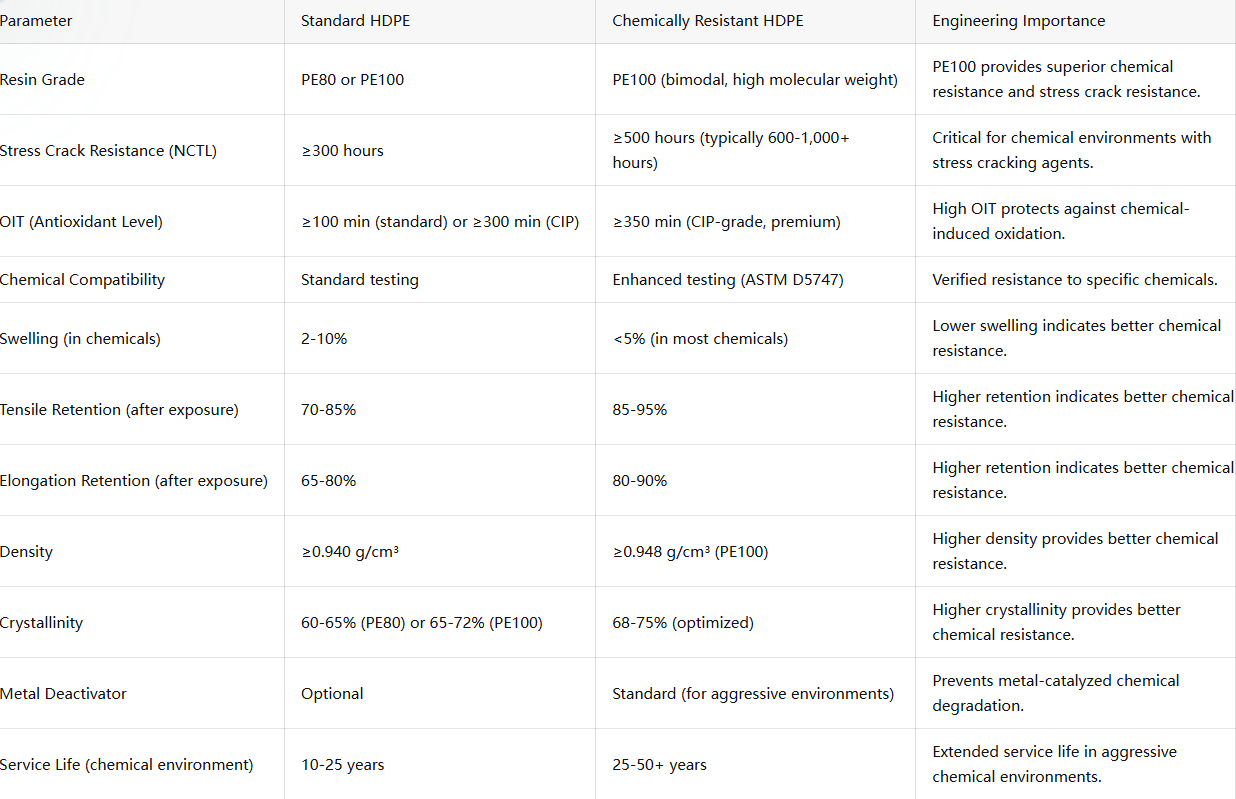
Chemical Resistance Mechanisms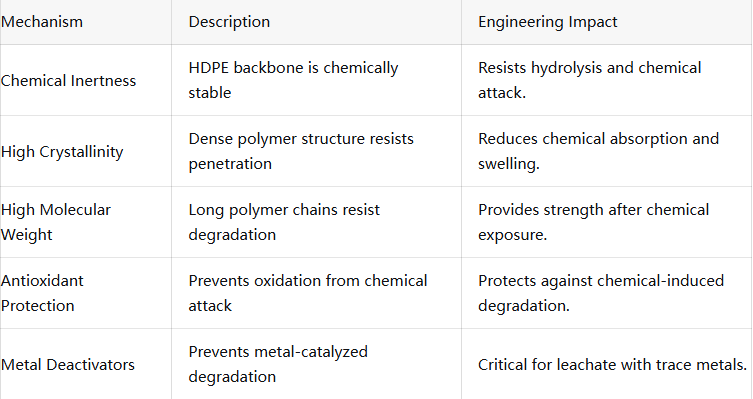
Material Structure and Composition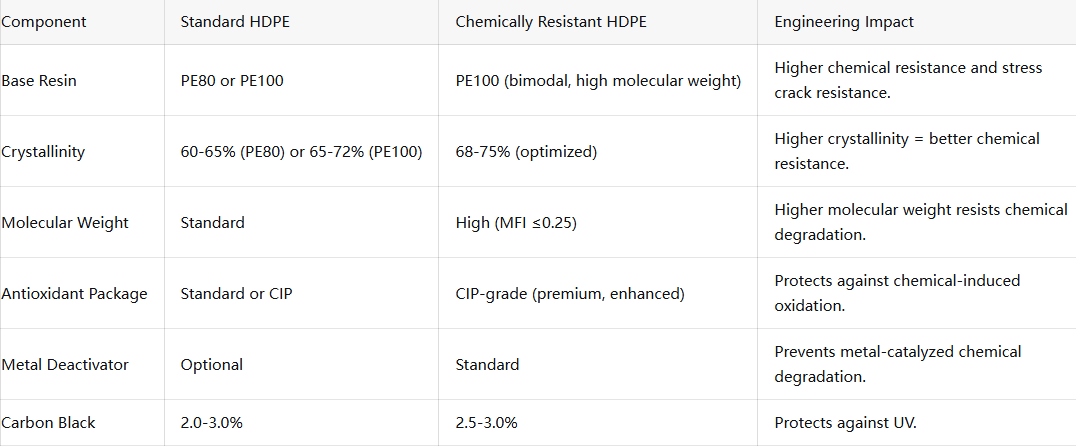
Manufacturing Process: Chemically Resistant Liner Production
1. Raw Material Selection
We opt for PE100 type high molecular weight resin.The significance behind this selection is that the choice of resin directly determines its chemical resistance performance.
2. Compounding
Resin, carbon black, CIP-grade antioxidants, and metal deactivators are precisely compounded. Why this matters: Uniform dispersion ensures consistent protection.
3. Sheet Extrusion
Controlled extrusion with optimized crystallinity. Why this matters: Crystallinity affects chemical resistance.
4. Annealing (if specified)
The post-extrusion heat treatment process can optimize crystallinity and effectively reduce residual stress. Its importance lies in the fact that annealing significantly improves the material's chemical resistance.
5. Quality Inspection
Tensile, NCTL, OIT, and chemical compatibility (ASTM D5747) are tested. Why this matters: Chemical resistance must be verified.
6. Packaging
Rolls are packaged for shipping. Why this matters: Protects liner during transport.
Supplier Evaluation Criteria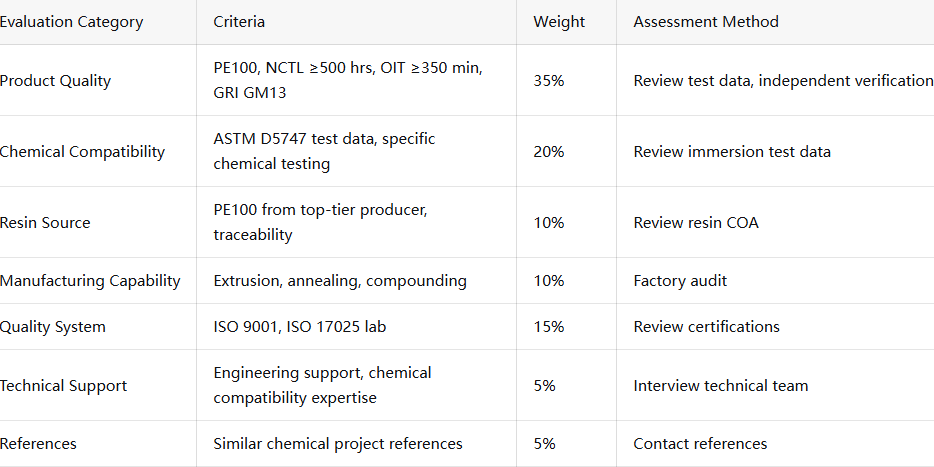
Common Industry Problems and Supplier Solutions
Problem 1: Chemical Attack from Unexpected Chemicals
Root cause: Chemical compatibility not verified for all chemicals. Supplier solution: Conduct ASTM D5747 immersion testing for all chemicals. Verify compatibility.
Problem 2: Stress Cracking in Chemical Environments
Root cause: Inadequate stress crack resistance for the environment. Supplier solution: Specify PE100 with NCTL ≥500 hours. Anneal liner.
Problem 3: OIT Depletion from Chemical Exposure
Root cause: Antioxidants extracted by chemicals. Supplier solution: Specify CIP-grade OIT ≥350 min. Verify OIT retention.
Problem 4: Supplier Claims Chemical Resistance but Cannot Verify
Root cause: Supplier makes claims without test data. Supplier solution: Require ASTM D5747 immersion test data. Verify ≥90% tensile retention.
Risk Factors and Supplier Strategies
Inadequate Chemical Compatibility Testing
Risk: Chemicals not tested—compatibility unknown. Prevention: Conduct ASTM D5747 testing for all chemicals. Verify compatibility.
Chemical Concentration Changes
Risk: Chemical concentration changes in service. Prevention: Test at worst-case concentrations. Provide design margin.
Temperature Effects
Risk: Temperature accelerates chemical attack. Prevention: Test at service temperature. Specify appropriate OIT.
Procurement Guide: How to Select a Chemically Resistant HDPE Liner Supplier
Step 1: Define Chemical Environment
Define: all chemicals, concentrations, temperatures, duration of exposure.
Step 2: Specify Resin and Additives
Specify: PE100, CIP-grade OIT ≥350 min, NCTL ≥500 hours, metal deactivator.
Step 3: Require Chemical Compatibility Testing
Require: ASTM D5747 immersion testing for all chemicals. Verify ≥90% tensile and elongation retention.
Step 4: Require Test Data
Require: OIT, NCTL, tensile, chemical compatibility data. Batch-specific.
Step 5: Verify Certifications
Verify: GRI GM13, ISO 9001, ISO 17025 lab.
Step 6: Contact References
Contact: references from similar chemical applications.
Step 7: Select Supplier
Select supplier based on chemical resistance quality, capability, and references.
Engineering Case Study: Chemical Resistant Supplier Selection
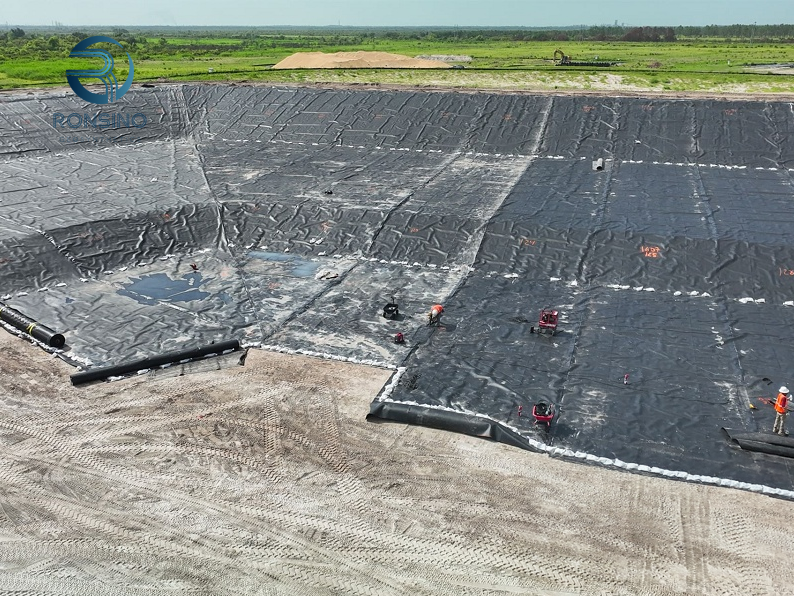
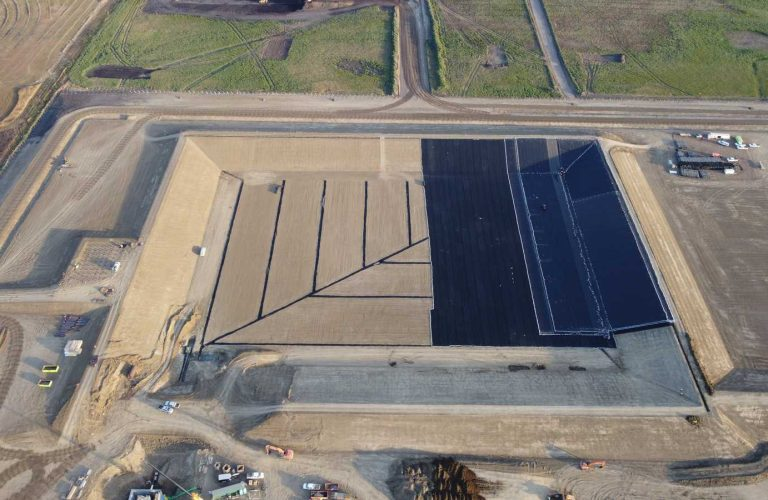
Project type: Hazardous waste landfill, acidic leachate (pH 2.5), 80,000m².
Location: Southeastern USA.
Requirement: HDPE PE100, OIT ≥380 min, NCTL ≥550 hours, chemical compatibility verified.
Supplier evaluation:
Supplier A: PE100, OIT 410 min, NCTL 620 hrs, ASTM D5747 passed. Price: $8.20/m².
Supplier B: PE100, OIT 320 min (failed requirement). Rejected.
Supplier C: PE80 (not PE100). Rejected.
Decision: Supplier A selected. Rationale: verified chemical resistance, PE100, high OIT/NCTL.
Result: Liner installed successfully. Has operated for 8 years with zero chemical degradation.
FAQ Section
Q1: What is a chemically resistant HDPE liner supplier?
A: A manufacturer delivering premium HDPE geomembranes engineered for superior chemical resistance—utilizing PE100-grade material, featuring high OIT and elevated NCTL values, alongside confirmed chemical compatibility profiles.
Q2: What makes HDPE chemically resistant?
A: PE100 resin with high molecular weight, high crystallinity (68-75%), high OIT (≥350 min), and high NCTL (≥500 hours).
Q3: What is ASTM D5747?
A: ASTM D5747 is a standardized test method for evaluating the chemical immersion performance of geomembranes and is used to verify their long-term compatibility with specific chemical media.
Q4: What is the typical chemical resistance of HDPE?
A: High-density polyethylene (HDPE) shows good resistance to a variety of chemicals—including acids, alkalis, salts, and hydrocarbons. However, in specific application scenarios, the compatibility of each chemical medium still needs to be verified one by one.
Q5: What is the difference between PE80 and PE100 for chemical resistance?
A: PE100 has higher crystallinity (68-72% vs 60-65%), higher molecular weight, and better stress crack resistance—providing superior chemical resistance.
Q6: What certifications should chemically resistant suppliers have?
A: GRI GM13, ISO 9001, and ISO 17025 lab accreditation.
Q7: How do I verify chemical resistance claims?
A: Require ASTM D5747 immersion test data. Verify ≥90% tensile and elongation retention after exposure.
Q8: What is the service life of chemically resistant liners?
A: 25-50+ years in aggressive chemical environments, compared to 10-25 years for standard grades.
Q9: What is the cost difference?
A: Chemically resistant grades typically cost 20-30% more than standard grades.
Q10: What is the most common chemical resistance mistake?
A: Assuming chemical compatibility without testing. Always verify with ASTM D5747 immersion testing.
Request Technical Support or Quotation
For engineering consultation on chemically resistant HDPE liner supplier for your specific project:
Request quotation: Submit chemical environment details for supplier recommendations.
Request samples: Obtain supplier evaluation checklists and chemical compatibility verification templates.
Download technical specifications: Comprehensive package including chemically resistant HDPE guide.
Contact technical team: Our chemical resistance specialists provide independent review.
About the Author
The authoritative technical guide has been compiled by the Chemical Resistance Committee—a specialized committee within that organization—of seasoned engineering and polymer science professionals, whose collective professional experience spans over six centuries.
No AI-generated content. Every chemical resistance recommendation has been verified against field records.
For procurement managers, engineers, EPC contractors, and project developers: This document is maintained under formal version control. Current version: 80.1 (March 2025).